
Serbia may not be the first country that comes to mind when visiting Europe. That said, this landlocked Central European nation actually has a lot going for it. Let’s go over the factors that make this country of almost seven million people a desirable retirement destination!
Table of Contents
Cost of Living in Serbia
Compared to other European countries like Switzerland, Norway, and Denmark, Serbia is actually surprisingly cheap in terms of cost of living.
A one-bedroom apartment outside the city center costs $250 per month while a three-bedroom apartment in the capital city center of Belgrade costs almost $1,200 per month — so rent is generally very affordable unless you’re looking for a large home in the capital.
Taxes in Serbia
Serbia taxes residents at a flat rate of 10% to 20% depending on the type of income being taxed. Employment income is taxed at a flat 10% rate (after deducting the non-taxable salary cap) while capital gains and investment income is taxed at 15%. Real estate income is taxed highest at a rate of 20%. Residents are taxed on their worldwide income while non-residents are only taxed on their Serbian-sourced income.
How to Become a Permanent Resident in Serbia
Serbia previously had €250,000 citizenship by investment program available for both EU and non-EU residents. However, this direct investment program is not currently available which makes it difficult to become a permanent resident in Serbia.
Those looking to enter the country will be best off applying for a temporary residence permit.
You can apply for a Serbian temporary residence permit for:
- Employment
- Study
- Medical purposes
- Training
- Family reunification
The application processes takes a couple of months but, if granted, provides a one-year temporary residence permit. The only documents you’ll need to apply are a valid passport, proof of income, health insurance, and accommodation receipts for the property you’ll occupy in Serbia.
After five years of legally residing in Serbia, you can apply for a permanent residency permit. After an addition eight years, you may become eligible for Serbian citizenship by naturalization — which carries quite a few perks!
Serbia Passport Visa-Free Countries
Serbian citizens are able to travel to 83 countries visa-free:

Serbia may not have the strongest passport in Europe (with only 83 visa-free countries unlike Malta‘s 114 or Spain‘s 117) but it still gets you access to the entirety of Europe (except the UK), most of South America, and the majority of continental Asia (except the southern nations).
Serbian passports tend to have major blind spots in North America, Africa, and Oceania so you may want to aim for another citizenship if visa-free travels in these regions is a priority.
Safety in Serbia
The Global Peace Index map shows that crime rates in Serbia are only slightly higher than in neighboring countries like Romania and Montenegro. In fact, its score of 1.83 nearly gets it into the top 50 safest countries.
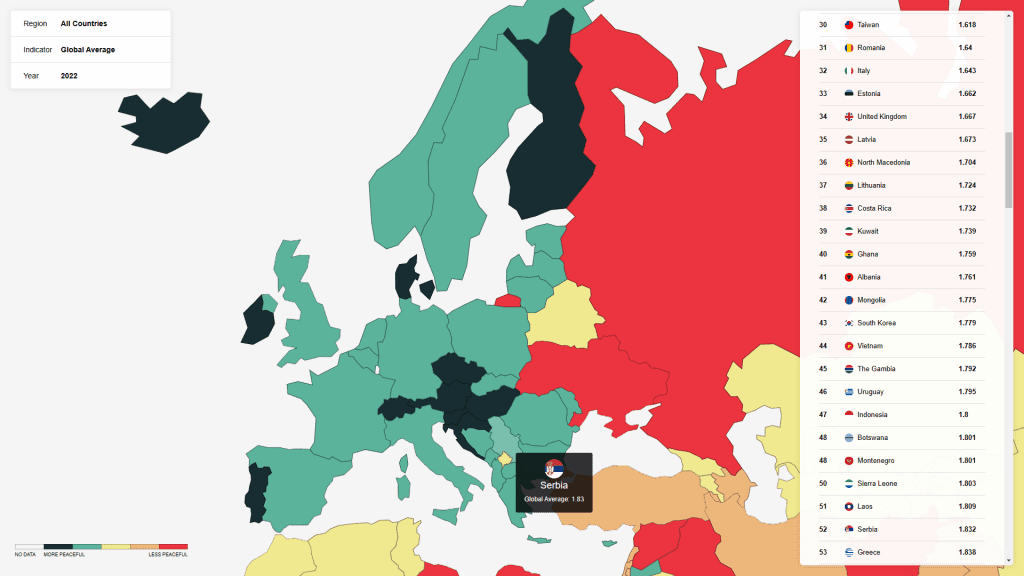
In contrast, countries like Somalia, Iraq, Russia, Syria, and Afghanistan all have scores above 3.0 which make them some of the most dangerous countries in the world. The US Department of State gives Serbia a Level 2 classification, asking that travelers exercise increased caution.
This is primarily due to organized crime in the country and potential violence at sporting events. However, petty crimes like pickpocketing are quite rare in Serbia — though you may want to keep an eye on your wallet when walking through crowds in Belgrade.
Conclusion
As you can see, Serbia is a cheap country to live in with safe streets and reasonable tax rates. Getting a permanent residency permit may be quite difficult but, if you manage to do it, you’ll likely find that the Republic of Serbia is a great (often overlooked) retirement destination in Europe!