
Those who want to retire in Asia often find themselves deciding between two countries: Japan or Malaysia. It makes a lot of sense since Tokyo and Kuala Lumpur are both in the top 10 most visited cities in Asia.
However, there are a few differences to consider before choosing which country to retire in. First of all, less than 20% of Japan’s residents speak English so you’ll most likely have to learn Japanese if you want to live in the country long-term.
This stands in stark contrast to Malaysia where more than 50% of its residents speak English (and even higher percentages in large cities like Kuala Lumpur). Expats also have to take the work culture differences into consideration.
Malaysian companies tend to offer a fairly standard work-life balance while employers in Japan will have you working through public holidays without any coffee breaks or sick leave. Language and corporate climate aren’t enough to make an informed decision so let’s look at other factors!
Table of Contents
Cost of Living in Japan vs Malaysia
Japan and Malaysia are both quite affordable compared to western countries like the US.
A one-bedroom apartment in a Japanese city-center will cost you around $680 per month. If you get a three-bedroom apartment in Tokyo then you’re looking at over $2,350 per month so the price really comes down to where in Japan you decide to live.
Rent in Malaysia can be as low as $230 per month if you get a one-bedroom apartment outside the city center. Even a three-bedroom apartment in the capital city of Kuala Lumpur will only cost $960 per month.
If you plan to buy real estate then Malaysia is also the better choice since Japanese real estate tends to be three times more expensive on a national level — and the gap is even more extreme in Tokyo, with prices as high as $9,000 per square meter!
Winner: Malaysia is decidedly cheaper to live in for both renters and homeowners.
Taxes in Japan vs Malaysia
Residents of Japan pay progressive tax rates up to 45%. Permanent residents are taxed on their worldwide income while non-residents are only taxed on their Japan-sourced income. You’ll probably also end up paying an extra percent in surtaxes.
Residents of Malaysia pay progressive tax rates up to 30%. Foreign-source income is exempt from taxation in Malaysia only if it was already taxed at the source country at a rate of at least 15% according to the Malaysian Ministry of Finance.
Winner: Malaysia has a lower maximum income tax rate and provisions for exempting foreign-source income that was already taxed at the source.
Japan vs Malaysia: Ease of Immigration
Those who want to live in Japan long-term usually only have three primary options:
- Working visa
- Spouse visa
- Citizenship by investment
Unless you plan to work for a high-stress Japanese employer during your retirement or marry a local just to live in the country, citizenship by investment is likely the most realistic option. Firstly, it’s worth noting that Japan’s CBI program is more stringent than other countries.
You won’t be able to park your money in a bank account or buy some real estate then call it a day. Instead, the business manager visa requires that you invest ¥5,000,000 as capital in your company and secure office space in Japan.
You’ll also need to get your business plan approved by local authorities and hire at least one full-time employee from Japan. If you were looking for a more passive method of buying your way into Japan, it simply doesn’t exist.
Malaysia’s DE Rantau program offers digital nomad visas with the goal of attracting residents from the IT, digital marketing, and content creation industries. The program is actually quite cheap with a base fee of RM1000 + RM500 per dependent (so a little over $300 for two people).
This is the easiest way to get yourself (plus any spouse or children) into Malaysia for the first one to two years. Those looking for a more permanent option should consider the Malaysia My Second Home program.
This provides foreigners (along with their spouse or children) with a 10-year multiple entry visa. To qualify for the program, applicants under the age of 50 will need a net worth of at least RM500,000 (a little over $100,000).
You’ll also need to provide the last three months of your bank statements to prove that your offshore income is at least RM10,000 per month (over $2,000 per month). Lastly, you’ll need to deposit RM300,000 (around $65,000) plus RM50,000 ($11,000) for each additional dependent.
After a one-year holding period, you can withdraw half of your fixed deposit but the remaining RM150,000 must remain in the account for the duration of your stay under the My Second Home program.
As a final note, both Japan and Malaysia don’t recognize dual citizenship so you’ll need to give up your current passport if you want to become a naturalized citizen of either country. The same is true for neighboring countries like Singapore.
Winner: Malaysia is the easier country to immigrate to with its digital nomad visas and affordable My Second Home program.
Location
The debate between which of the two countries have a better location really comes down to the weather conditions in Northeast Asia and Southeast Asia respectively. Japan is located in Northeast Asia and as a result is hit by typhoons quite often.
In fact, Japan receives an average of 14 typhoons per year.
Malaysia, located in Southeast Asia, rarely experiences typhoons at all. The country only gets a couple of typhoons per year, usually in the peak months of August and September. Beyond weather, Malaysia also has more favorable borders.
Malaysia borders Thailand to the west, Indonesia to the east, and Singapore to the south — all of which are quite popular tourist populations. Conversely, Japan has no land borders which means you’ll need to take a plane or boat if you want to travel outside the country.
Winner: Malaysia’s location leaves it less susceptible to typhoons and more conducive to travel.
Safety
Japan and Malaysia are both relatively safe countries — but Japan has a lower homicide rate.
Japan has the 12th lowest intentional homicide rate in the world according to the United Nations Office on Drugs and Crime. This puts it just slightly behind countries like Singapore, Luxembourg, and microstates like Monaco or San Marino.
Malaysia ranks 116th on the UNODC list with an intentional homicide rate of 2.1 per 100,000 inhabitants. This is still lower than other Southeast Asian countries like the Philippines and East Timor which average more than four intentional homicides per 100,000 inhabitants.
On the Global Peace Index map below, you’ll find that both Japan and Malaysia rank in the top 20 safest countries. However, Japan is technically safer and is ranked at the 10th spot compared to Malaysia at the 18th position.
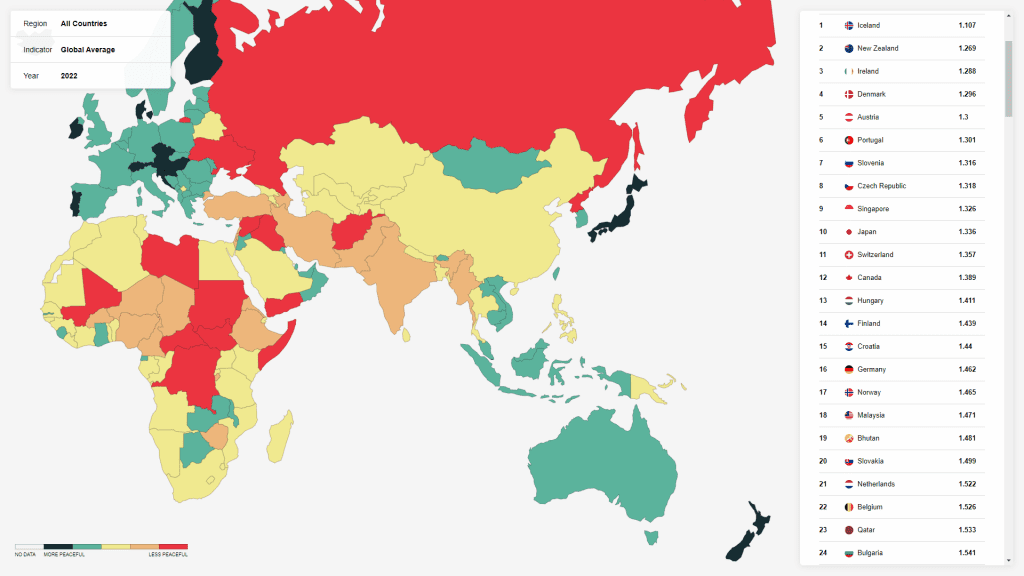
Winner: Japan is widely known as one of the safest countries in the world but both nations have impressively low crime rates.
Japan vs Malaysia Conclusion: Where Should You Retire?
As picturesque as Japan is, retiring there is easier said than done. Even if you manage to obtain permanent residency you’ll still be paying a lot more for accommodation and may struggle to get past the language barrier.
Malaysia, on the other hand, offers multiple affordable ways to move to the country and boasts significantly cheaper housing prices. Severe weather is also far more uncommon in Malaysia which, alongside the higher prevalence of English-speakers, make the country a great choice.
If you’re intent on living in Japan then all the more power to you. It does have its merits like being one of the safest countries in the world and also having the third largest economy. As for me, I just can’t justify the higher tax rates and rent prices so I’d go for Malaysia every single time.
Whichever country you decide to retire in, I hope this article has been helpful in your journey on how to Live After Success!